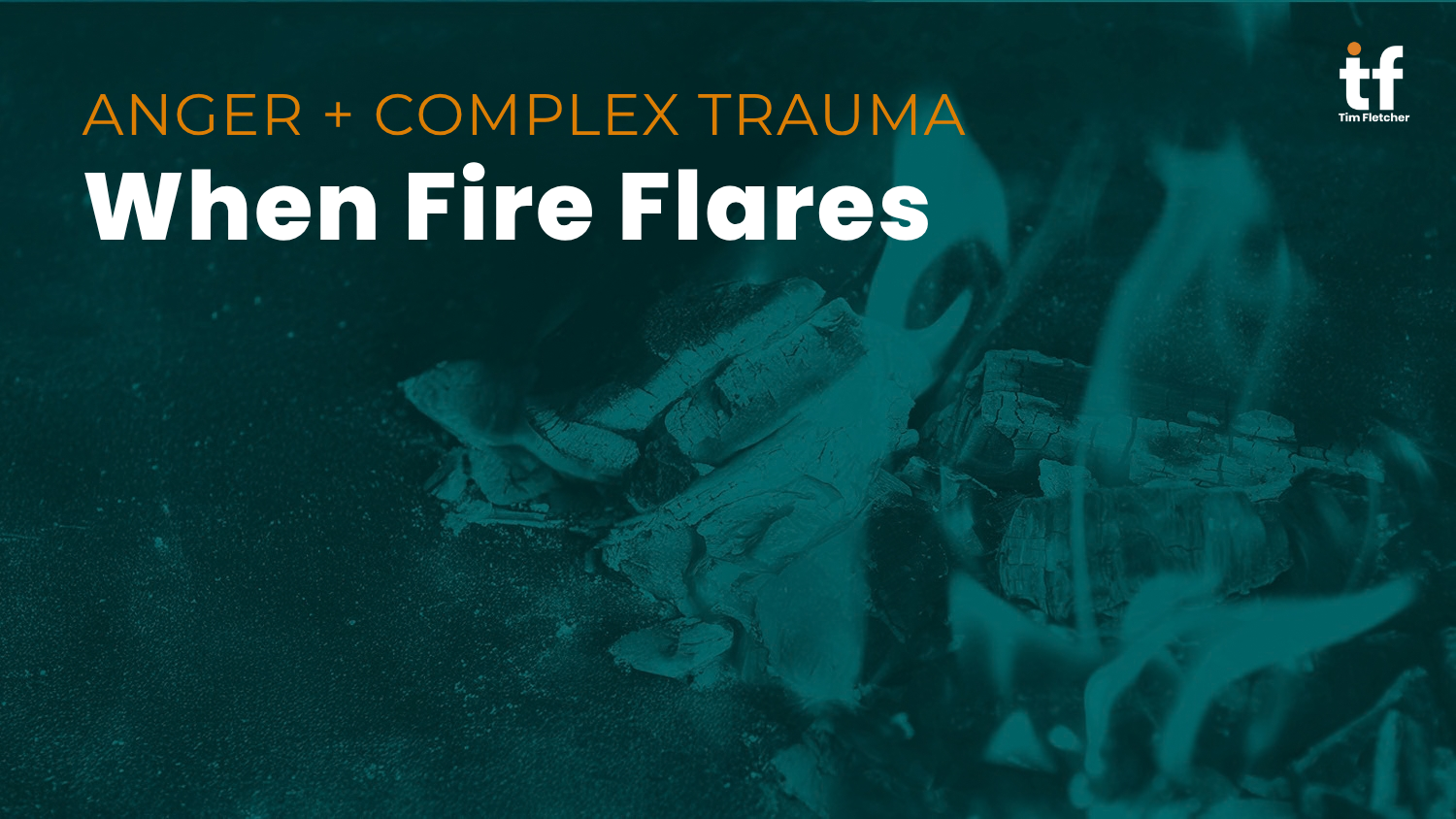
Anger and Complex Trauma: When Fire Flares
You know your anger is building, but by the time you notice, you're already halfway into the reaction, the sharp word already out, the door already slammed.
Understanding where the anger comes from is one thing. Knowing what to actually do in that fraction of a second is another problem entirely.
In this course, you'll look at what happens inside you the moment a trigger fires, from the body's first signals through the cortisol response that shuts down clear thinking and hands control to a faster, more reactive part of the brain. You'll learn practical ways to pause without stuffing the feeling down, ground yourself back into calm, and figure out whether a flare-up is really about the moment in front of you, an old wound it touched, or some blend of both. You'll also explore how to decide when to let something go and when it's worth addressing directly, along with how a daily check-in can catch rising tension before a small trigger turns it into a full eruption.
By the end, you'll have a working set of tools for the moment the fire actually flares, not just an understanding of why it started. Rather than treating each blow-up as proof that nothing can change, this course points toward a steadier sense of choice, so you can respond differently, imperfectly at first and more consistently over time.

Get Access with the FOUNDATIONS Membership
Get unlimited access to Tim Fletcher Co’s Evergreen library for just $30 per month, or $300 per year. With new self-development courses added every month, you’ll always have fresh, practical tools to support your growth in areas like trauma recovery, boundaries, relationships, and personal transformation. Learn at your own pace, revisit lessons anytime, and build lasting change with guidance that’s both compassionate and deeply practical. See more details here.
*All prices are in Canadian Dollars.
Course Curriculum
-
Understanding anger is one thing. Knowing what to do in the instant it flares, when everything in you wants to lash out or shut down, is another. This course picks up there, mapping what actually happens inside the nanosecond between a trigger and a reaction.
Learners will begin understanding how to calm the fire, find what it is really about, and choose a different response than the one it demands.
-
Two people can face the exact same comment, and one stays calm while the other ignites instantly. The difference is rarely the comment itself.
This module slows down the nanosecond between a trigger and a reaction, tracing the cascade of body sensations, distorted thinking and pulled-toward action that fires before a person is even aware it started, and shows how cortisol shuts the thinking brain down and hands control to the limbic brain.
In this module you'll:
Slow down the "nanosecond" so you can see what happens inside it.
Recognize the five-part pattern: trigger, body, thinking, emotions, action.
Understand how cortisol shuts down the thinking brain and hands control to the limbic.
See how the limbic "solutions" feel like relief but feed the anger.
Begin changing the narrative from "it just happens to me" to "I have a pattern I can learn to see."
Lesson • Video • Journal
-
The exact same comment from a stranger and from a parent can land completely differently. That gap says something about where the real charge is coming from.
This module maps the many recurring triggers that come with Complex Trauma, from injustice and disrespect to boundary violations, and shows how a trigger is almost always connected to an old, unhealed wound, so that a reaction that looks disproportionate is actually responding to today plus everything it recalls.
In this module you'll:
Map your main anger triggers and see why they vary in intensity.
Recognize anger as a "secondary emotion" that covers weaker ones.
Understand that a trigger is connected to an old, unhealed wound.
Learn to look past the anger to the hurt underneath.
Use gentle tools to trace a trigger back to its original wound.
Lesson • Video • Journal
-
Trying to reason through a conflict mid-flare can feel a lot like trying to read in the dark. Nothing said in that state tends to land the way it was meant to.
This module distinguishes pausing anger from stuffing it, introduces practical grounding tools like slow breathing and stepping away that bring the thinking brain back online, and warns that almost any calming tool, from a walk to a phone call, can turn into fuel if attention drifts toward the grievance.
In this module you'll:
Understand "biting your tongue" as pausing anger, not stuffing it.
Learn why you must de-escalate before you can think clearly.
Learn practical grounding tools to get back to the cortex.
Recognize the pitfalls that can turn a calming tool into a fire-stoker.
Use your body's early signals to catch the fire before it completes.
Lesson • Video • Journal
-
In the heat of anger, a hurt can feel like it is a hundred percent someone else's doing. Once the body calms down, the picture is rarely that simple.
This module walks through the clarifying questions that help separate what actually caused the anger from unmet expectations, and introduces the central question of processing: whether a flare is mostly a person's own stuff, genuinely someone else's, or some blend of both.
In this module you'll:
Understand why seeing the situation accurately is the goal of processing.
Learn the questions that clarify what your anger is really about.
Work out what is your part, their part, or a blend, with humility.
Use an honest self-inventory to recognize when the anger is mostly your own.
Recognize the dangers of processing: re-escalating, and sliding into obsession.
Lesson • Video • Journal
-
Deciding to let something go rarely works as a single decision made once and finished. The mind tends to drag the grievance back up, sometimes within minutes.
This module explores how to decide between letting anger go and addressing it directly, treats letting go as a practice repeated each time a grievance resurfaces, and introduces a daily inventory that can catch a rising baseline before a small trigger sets off a full eruption.
In this module you'll:
Learn how to decide whether to let anger go or address it.
Understand that letting go is repeated, not one-and-done.
Shift from reacting to anger to getting ahead of it with a daily inventory.
Learn your early warning signs and prepare for known high-anger situations.
Reclaim the sense that you are not a victim to your anger.
Lesson • Video • Journal