

Why Holiday Giving Can Feel So Unsafe for the Complex Trauma Survivor
Understanding the Hidden Triggers, Releasing the Compulsion, and Finding True Connection
You've felt it, that tightness in your chest as you scroll through endless gift options. That knot in your stomach when you imagine their reaction. The mental fog, the irritability, the sheer exhaustion that seems to descend every December. You tell yourself it's just the "holiday stress" everyone complains about, but deep down, it feels different. It feels unsafe.
For the complex trauma survivor, holiday giving is rarely just about generosity. It becomes a high-stakes performance where our deepest fears of abandonment, rejection, and worthlessness are activated. Our nervous system, shaped by childhoods where love and safety were conditional, now interprets the simple act of choosing a gift as a potential threat to our very connection and belonging.
This isn't a character flaw. It's a brilliant, adaptive survival strategy, your body and mind remembering what they had to learn to navigate a world that felt unpredictable. The complex trauma symptoms of perfectionism, avoidance, numbness, or over-giving that flare up during the holidays are not random. They are precise, protective responses to old, unseen wounds.
Let's gently unpack what is truly happening within you, so you can move from a place of trauma-driven compulsion to one of conscious, connected choice.
When Gifts Become a Measure of Worth
In a healthy childhood, gifts are an expression of love, freely given and received. But in a home marked by complex trauma in adults (who were once traumatized children themselves), giving and receiving often came with invisible strings.
Perhaps your joy had to match the giver's expectation, or your disappointment had to be hidden to protect a fragile ego. Maybe a gift was used as a tool for control—given as a reward for compliance or withheld as punishment. You might have learned, deep in your nervous system, that your worth was transactional. To be accepted and safe, you had to perfectly manage the emotions of others through your actions, your reactions, and your gifts.
This creates what we in complex trauma recovery call a core belief: "I must earn my place. My value depends on your approval."
So when the holidays arrive, your system isn't preparing for a celebration—it's preparing for an evaluation. The old, terrifying abandonment melange—that cocktail of fear of abandonment, rejection, and crushing shame—gets triggered. You aren't just picking out a sweater; you are, in your body's memory, trying to secure your right to exist in the family without being cast out. This is the heavy, silent strain beneath the wrapping paper.
Your Body's Survival Map: The 5 Trauma Responses to Holiday Giving
When your nervous system perceives a threat (even a symbolic one like a gift exchange), it mobilizes ancient survival strategies. These are your survival adaptations, and they manifest in specific ways during the holiday season. Seeing them clearly is the first step toward compassion.
1. Fight: "If I'm perfect, I'll be safe."
This response turns gift-giving into a high-pressure campaign. The inner critic takes over, fueled by fear.
What it looks like: Frantic perfectionism. Hours of research, comparing prices and reviews, overwhelming yourself with choices. Underneath the hustle is anger driven by fear, fear of judgment, of letting someone down, of being seen as uncaring.
The inner narrative: "This has to be flawless, or they'll know I'm not good enough."
2. Flight: "If I avoid it, I'll be safe."
Here, the perceived danger is the emotional risk of choosing wrongly. The goal is to escape.
What it looks like: Procrastination until Christmas Eve. Becoming suddenly "too busy" with other tasks. Physically avoiding malls and websites. It's not laziness; it's your system trying to outrun the anxiety of potential failure.
The inner narrative: "I can't handle the pressure. If I don't try, I can't fail."
3. Freeze: "If I disappear, I'll be safe."
When fight and flight seem impossible, the system shuts down. This is a common complex trauma symptom when overwhelmed.
What it looks like: Standing paralyzed in a store aisle, mentally blank. Scrolling mindlessly without the ability to decide. This often spirals into shame: "Why can't I just do this simple thing?"
The inner narrative: "I'm stuck. I don't know what to do. I'm incapable."
4. Fawn: "If I please you, I'll be safe."
This is perhaps the most common survival adaptation in holiday giving. Fawning is the compulsion to appease and people-please to secure safety and connection.
What it looks like: Grossly overspending beyond your budget. Exhaustively tailoring gifts to what you think will keep someone happy. Abandoning your own boundaries of time, energy, and finances. As Tim Fletcher explains in his series on codependency and complex trauma, fawning is a strategy born from a lifetime of managing unstable environments by managing others' emotions.
The inner narrative: "What do you need from me to be okay, so that I can be okay?"
5. Flop: "I surrender. I have nothing left."
This is the collapse response when all other strategies are exhausted. The system simply gives up.
What it looks like: Emotional numbness. Giving a generic gift card or nothing at all, not from malice, but from utter depletion. Feeling dissociated or checked out from the festivities.
The inner narrative: "I don't have anything to give. I am empty."
Recognizing yourself in these responses can be a powerful "aha" moment. It allows you to say, "Oh, this isn't me being 'bad at Christmas.' This is my nervous system trying to protect me from an old, remembered wound." This is the foundation of compassionate curiosity.
How Do We Move From Survival to Connection
The path forward isn't about forcing yourself to be different. It's about bringing awareness and kindness to these terrified parts of you, and gently updating your system's safety map. True complex trauma recovery happens in the nuance of these daily choices.
Step 1: Pause and Connect with the Present Moment
Before you buy, wrap, or plan, pause. Place a hand on your heart or belly. Feel your feet on the ground. Take three slow breaths.
Ask this pivotal question: "What would I choose if I weren't afraid?"
Listen for the quiet, gentle answer beneath the panic. It might be a simple, heartfelt gift. It might be the desire to set a budget. Trust that whisper. It is your authentic self, not your trauma, speaking.
Step 2: Offer Your Inner Child Reassurance
That feeling of urgency and dread often belongs to a younger part of you. Speak to them with softness.
You might whisper inside: "We are not in that old house anymore. We are not earning our safety today. We are adults, and we are safe. We can give from a place of love, not fear."
This practice of internal reparenting is a cornerstone of healing complex trauma in adults.
Step 3: Re-draw the Boundary of Responsibility
This is crucial. You must separate the act of giving from the receiver's reaction.
Your responsibility: To choose a gift with thoughtful intention, within your healthy boundaries.
Not your responsibility: To manage, control, or guarantee the other person's happiness, approval, or emotional state.
Their reaction is about their story, their expectations, their inner world. It is not the final grade on your worth as a person. As resources on mental health and relationships emphasize, healthy connection can withstand the minor disappointment of an imperfect gift.
Step 4: Give the Greatest Gift to Yourself
What if your own care was part of the holiday equation? This is revolutionary for the trauma survivor.
The gift of permission: Permission to not be the family's emotional caretaker.
The gift of rest: A deliberate pause amidst the chaos.
The gift of "enough": The firm, gentle reminder that you are already enough, before you give a single thing.
By including yourself in the circle of care, you actively repair the old wound of neglect and teach your nervous system that safety comes from within, too.
Your Worth Is Not Wrapped in a Box
Complex trauma taught you that connection was a transaction—that you had to perform, perfect, and please to be worthy of love. The holidays, with their focus on gifts, can feel like the annual audit of that worthiness.
But here is the truth your body is learning to remember: Your worth is inherent. It was placed in you at birth. It cannot be earned, and it cannot be lost by a missed gift receipt or a less-than-thrilled reaction.
This season, you have an opportunity to practice a new way. To let your giving be an extension of your heart, not a ransom for your safety. To let your presence be the present. It is a practice, not a perfect performance. One small, gentle choice at a time, you can teach your system that it is possible to feel connection without compulsion, and to find safety within yourself, long after the last gift is opened.
Take a breath. You are already home. You are already enough.
Our Journey of Healing Continues
If the insights in this article resonated with you, and you are ready to dive deeper into healing the relational patterns shaped by complex trauma, we invite you to explore our transformative mini-course bundle.
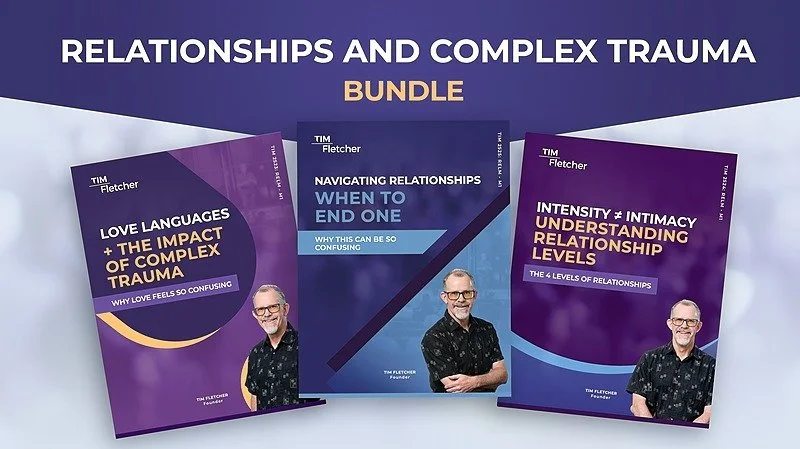
This special bundle includes three essential courses designed to guide you toward healthier, more fulfilling connections:
Love Languages: Move beyond simplistic formulas to understand how to give and receive love in ways that truly build security and trust.
Navigating Relationships: Gain practical tools for setting boundaries, communicating needs, and discerning between healthy and unhealthy dynamics.
Intensity ≠ Intimacy: Unpack one of the most common traps in relationship dynamics, learning to distinguish between drama-fueled intensity and genuine, secure intimacy.
Begin your journey toward secure and authentic relationships.
GET STARTED FOR $45